
Guide 6 of 10
Why brick, coated cladding and trim need separate lines in an exterior bid
A single colour can run across several materials. Use a simple photo key to show which surface is being finished, what condition it is in and what sits beside it.
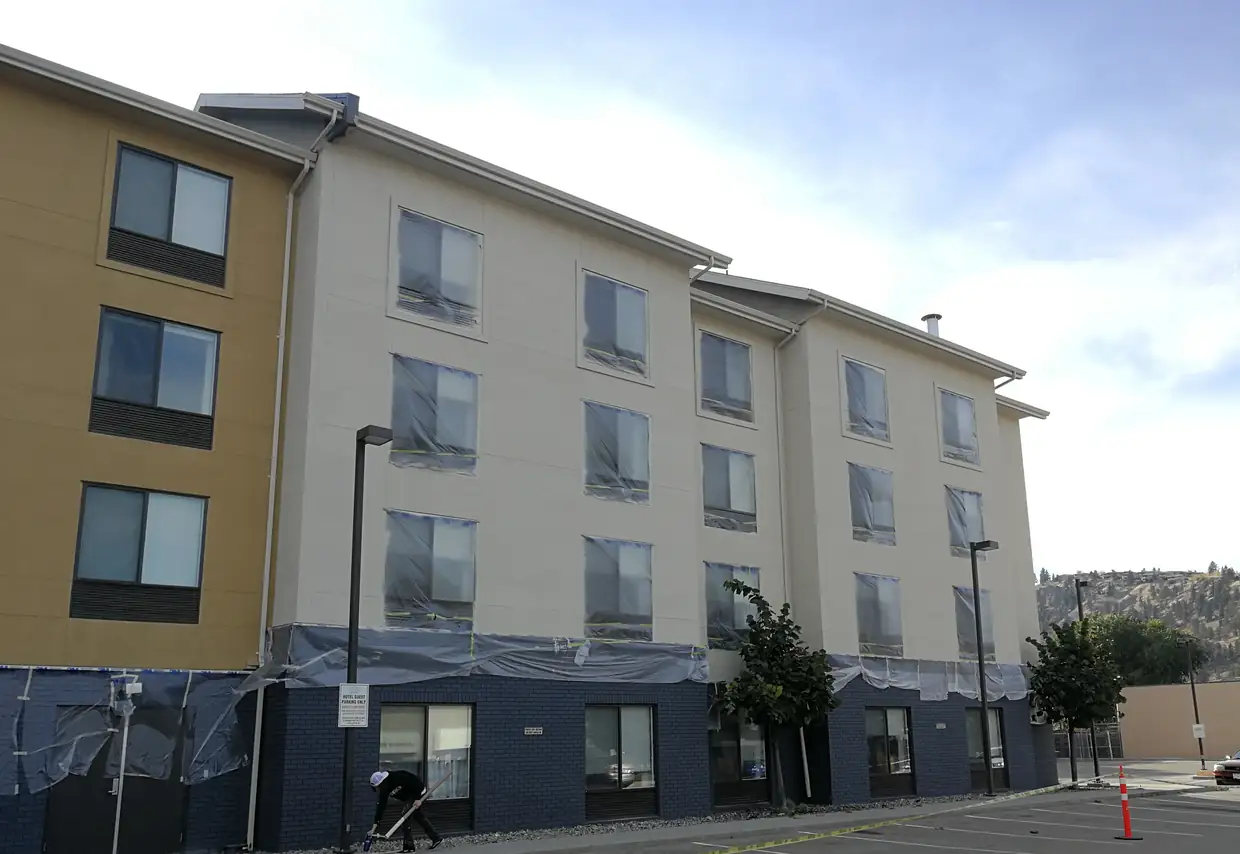
Stand across the street and the front of a hotel can read as two colours. Walk the same wall with the person pricing it and the list gets longer. A textured field, a previously coated panel, a window return and a metal edge can all share one colour. Each has its own existing finish, condition and boundary. Separate those details before comparing bids.
Give the photo a key
Take a wide photograph of one elevation and give each material a letter. On an illustrative building, A might be an existing coated wall, B the brick base and C the narrow trim beside the windows. Use the same letter wherever that surface repeats. Under the photo, write what you know about the material and previous coating, which parts the owner wants painted, and which parts need inspection.
At Fairfield Inn & Suites in Kelowna, the 2018 project brief identified stucco, brick and specified new windows. Our photos show masking around guest-room windows and the lift at the entrance. The word “specified” matters. A picture of a wall full of windows cannot tell a bidder which ones the owner approved.
Give the exception its own line
Suppose most panels look uniform but four near the receiving door have worn differently. Keep the four on the same photo and add a close-up and a sublabel, such as A2. Ask the estimator what can be assessed during the walkthrough and what needs a test or an agreed allowance. A condition observed from the pavement is useful information. Choosing a preparation or coating system requires a closer assessment of the actual surface and product directions.
For another example, the Vine Dental exterior puts a dark wall, reflective glass, grey block and an entrance screen in the same view. It is easy to point to the building and miss where one material stops beside another.
Use the key to read both quotes
Ask each bidder to state the preparation and intended finish for A, B and C, along with the limits of the work and any protection needed. If a quote leaves B blank, ask what was assumed before comparing the totals. Save the approved key with the finish schedule. A manager can later point to the exact area when a repair or touch-up is needed.